One of the most influential (and practical) academics in the entrepreneurship world is Steve Blank. His Four Steps to the Epiphany or Lean Launchpad delivered as part of NSF i-Corps have shaped generations of founders globally, specifically in how they approach customer discovery and development. A recent article by Steve Blank, “AI and Teaching – The Brave New World”, explores what is happening on the ground in startup education right now. And it is really 'insightful'.
It doesn’t celebrate or dismiss AI. Instead, it identifies what can go wrong when the speed of building outpaces our own human speed of learning.
From scarcity to abundance
For years, one of the key constraints in startup progress was the ability to build. Minimum Viable Products (MVPs) took time, resources, and technical capability. That's why Steve (and CBRIN) as well as many other resources did not recommend that entrepreneurs 'build first'.
That constraint has largely disappeared with introduction of vibe coding and arrival of multiple open platforms, inlcuding ones that let you stich a prototype for free.
Students in Blank’s classes are now showing up with working products on day one. Ideas can be turned into something tangible really fast.
What an amazing acceleration of the startup building progress. Almost infinite iterations that are possible to dream up and deploy to test users very quickly.
This changes the game. However, as Steve observes, it also introduces some new bottlenecks.
More product, less insight
What Blank describes is something we are also becoming increasingly aware of:
- Teams can now build faster than they can think!
- They generate more products than they can reliably validate with human users
- They can easily mistake the development of features for the development of deep understanding
The core issue is what Steve calls an “impedance mismatch” between product development and learning. What really matters but is harder to outsource to AI is:
- Choosing the right problem.
- Interpreting weak signals from customers.
- Deciding what to ignore.
AI is making customer discovery harder
It is sort of counterintuitive.
AI accelerates building, but it can degrade the quality of learning:
- Teams rely on AI to generate communication with customers, which reduces their ability to develop, own and act on insights from this communication
- Customer interactions become superficial and more frequent or volume focused rather than insight rich and real
- Validation gets replaced by infinite assumption generation that can be quickly and cheaply turned into (too many) product versions (customer's role in this is marginal)
Blank notes that teams started producing what he calls “AI slop” when they outsourced the thinking and interaction to tools.
The market has changed as well
There is a second-order effect that is easy to miss.
Customers themselves are now being disrupted by AI.
Some of the companies students spoke to weren’t just evaluating new tools. Most were questioning whether and how their business would exist at all.
During the validation the students observed :
- Data is no longer freely shared
- Organisations are more defensive
- Proprietary data becomes one of the few remaining moats
What comes next: from product to outcome
One of the more interesting signals in the article is the move from:
- Product/market fit
to - Agent/customer outcome fit
Customers don’t want more dashboards.
They want outcomes delivered.
AI agents will increasingly take on the “doing”, not just the “informing”.
That changes what we build, how we measure success, and how we engage users.
What this means for founders in Canberra?
We see three implications worth calling out for our ecosystem.
1. The barrier to entry has dropped. We expect to see more founders.
Anyone can build. This activity has been democratised and removed from the moated part of your business. Especially in the early stage. What you need to focus on is how you develop your own ability to find, interpret and act on market signals correctly. Sometimes a confused user means that the product should not exist rather than that the button should move somewhere else on the page. But definitely more people can now give it a go. And that's a good thing. We need more entrepreneurs (and more diverse pools of them) to be engaged in trying to solve problems through innovative entrepreneurship. And they may need less resources to start - smaller teams, faster time-to-prototype.
2. We need more focus on valdation and insight building as a skill.
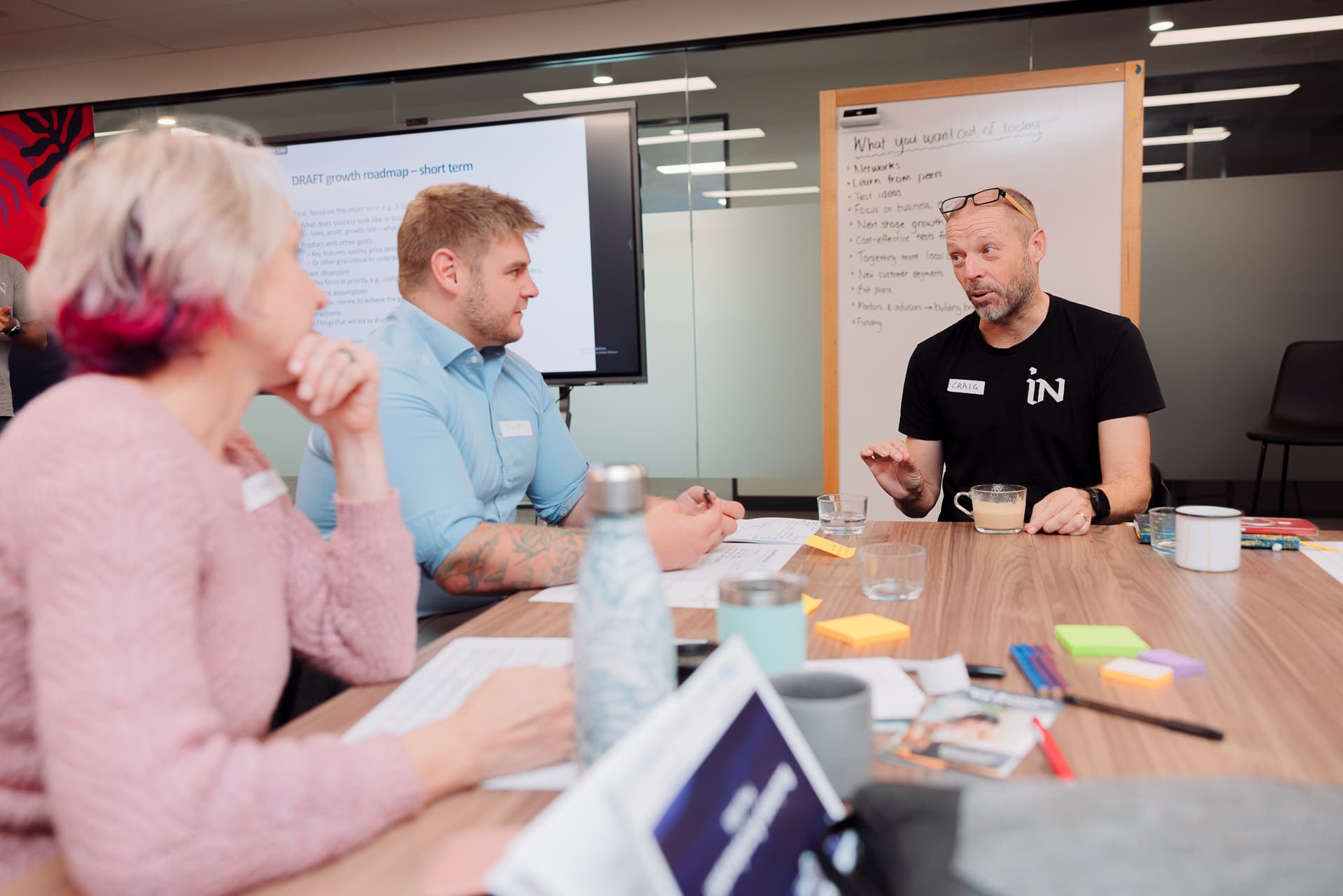
CBRIN programs have alsways focused on developing the founder soft skills - negotiation skills, customer conversations, assumption identification and testing, pitch planning and delivery, collaborative capacity, and the ability to develop networks of humans important for your progress. These become even more important skills that augment your ability to ship releases quickly. You will need to invest in them more and do it consciously because the trap that ai aided product development has prepared for your focus is very seducive. Please, do not automate customer insights development. By definition, they will not be insights. They will be plausibly sounding ooutputs of LLM interactions.
3. Relationships and collaboration will matter more.
As data becomes guarded and markets (customers) become more uncertain and volatile, trust becomes even more critical value driving asset. Human to human relationships, ability to build them, to follow-up and provide reciprocal and genuine value (often in a pay-it-forward way and with abundance mindset), the ability to start and meaningfully maintain collaborations will be core to your ability to build innovative businesses successfully.
This aligns with what we focus on consistently across CBRIN programs and events. Connect to any one of them and you will find that it is less about a paricular porduct or platform and more about critical thinking, connections, practical opportunities, relationships, collaboration and a whole range of soft entrperneurial skills.
Final thought
AI has compressed the time it takes to create something.
It has not taken away the need to really understand whether it should exist.
Historically, and with the evolution of AI even more, that is where most of early stage risk continues to be.
The good news is that you can continue building the human skills and capacity to reduce this risk. Through learning, insights, and developing high quality, rich human-to-human relationships.