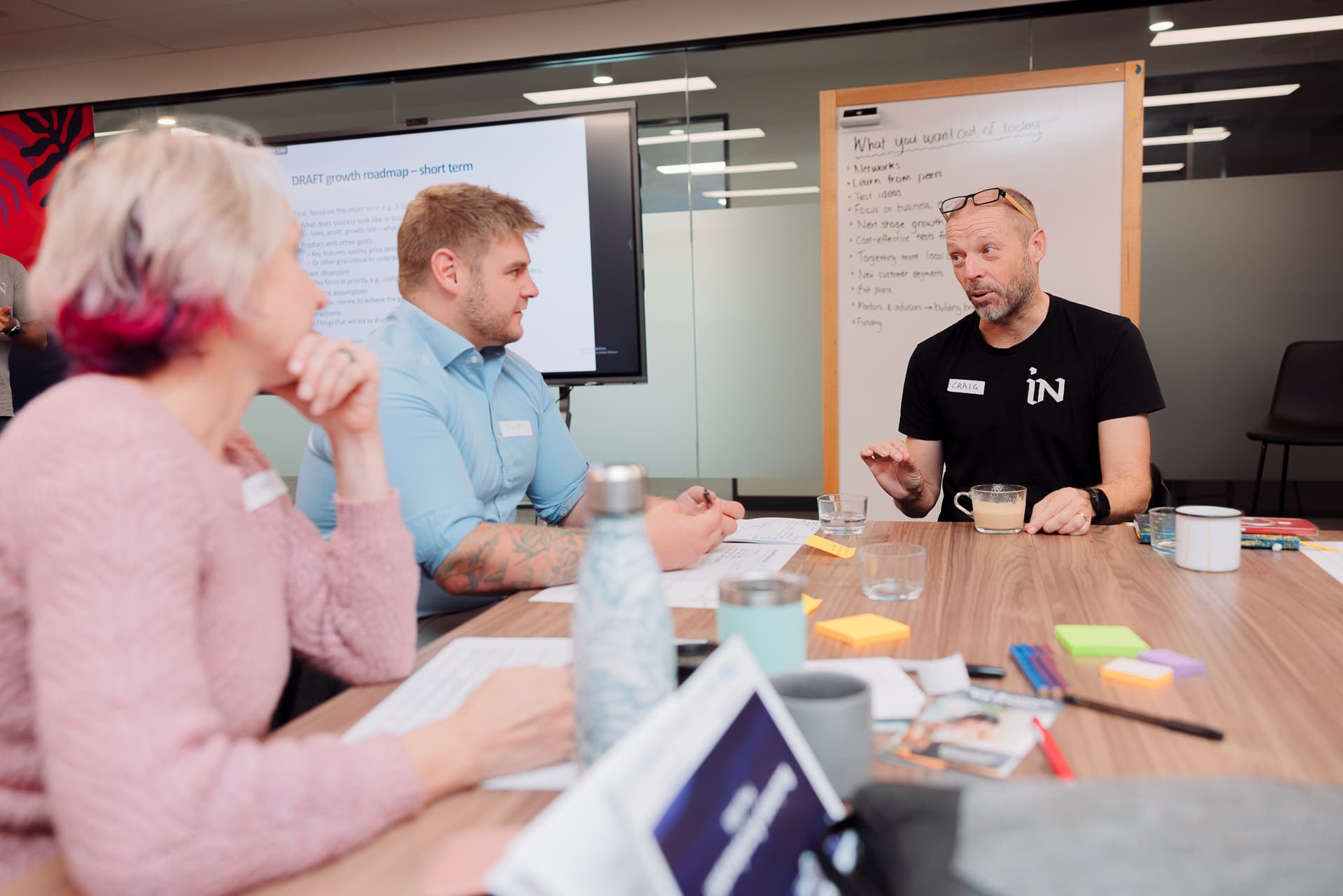
On a Wednesday 8 April, the freshly refurbished event space on Level 5 at the Canberra Innovation Network (CBRIN) filled with members of the local innovation community for the launch of Handbook of Innovation Ecosystems by Dr John Howard. The book features Canberra innovation ecosystem prominently, as a case study number one, a model on which all other case studies in the book were researched. The occasion drew a panel of four: ACT Chief Minister Andrew Barr; Dr Howard himself, an innovation policy researcher and author; Michelle Jasper, Chair of the CBRIN Advisory Committee and PhD candidate at the ANU; and Petr Adamek, CEO of CBRIN. What followed was a wide-ranging conversation touching on the city's past, present, and future as an innovation hub — and those who couldn't make it missed a genuinely energising discussion. Here are the key highlights.
Relationships matter
Dr Howard opened with a provocation drawn from his research into innovation ecosystems globally. The classic "Triple Helix" model — the interconnection of universities, business, and government — has long been depicted as a diagram of institutions linked by channels. But after studying more than 90 ecosystems worldwide and developing 20 detailed case studies, Howard's conclusion was that the diagrams may show the linkages, but what actually matters are the flows through it.
"The quality of relationships matters more than the quantity of connections. People connect places — through trust, shared purpose, and repeated interaction."
One finding stood out in particular: Australia's persistent weakness is not a shortage of funding or research talent, but a coordination failure. And at the firm level, a "management chasm" — SMEs that lack the financial literacy, governance capability, and scaling competency to absorb and apply new technologies — is a structural drag on the country's innovation performance. This, Howard noted, is consistent with Roy Green's broader research on Australian business management.
Canberra is an innovation city. And it's on a journey.
Chief Minister Andrew Barr was asked bluntly: is Canberra an innovation city? His answer was characteristically measured — "yes, but it's a journey" — before unpacking a decade of deliberate strategy.
Barr traced the logic back to basics: Canberra's comparative advantages are real but asymmetric. The workforce is the best-educated and most productive in the country. The higher education sector is both the city's largest export industry and its biggest employer outside the public service. But historically, access to capital has been the city's Achilles heel — a problem Barr framed as "centuries old" in the Australian context, and especially acute for a young city without deep pools of private wealth.
The government's response has been to use its unique position as a combined council and state government — with control over land use, planning, and taxation — to create enabling conditions rather than direct the market. Special economic zones anchored by the Universities are the most visible expression of this. A venture capital fund with matched private investment is part of the answer to the capital gap; so is a growing cohort of founders who have had exits and are beginning to pay it forward.
The Commonwealth government as a 25-year tenant creates risk-averse investment patterns. Private capital flows toward housing because the incentives point that way. Incentivising private capital flows into innovation will require changes in the federal tax policy.
A corridor, not just a collection of hotspots
One of the more tangible ideas discussed by the panel was the concept of an innovation corridor running from Bruce through CSIRO and ANU, through the city centre, past UNSW Canberra at ADFA, and out to the airport — where significant innovative activity is already emerging. It was acknowledged that the corridor idea was first introduced by Dr Victor Pantano more than a decade ago.
The panel drew on international examples: Toronto's innovation corridor or Munich's integration of city and valley. Canberra, historically described as "100 suburbs in search of a city," has an opportunity to do this differently. "Innovation train" (Light-rail line from Belconnen to Canberra Airport) was mentioned as a way to accelerate connectivity within the corridor and intensify the flow of people.
The practical challenge ahead is a wave of 1990s Commonwealth buildings coming available for adaptive reuse. Chief Minister challenged the community to look into these significant opportunities: mixed-use spaces capable of hosting entrepreneurs, researchers, accommodation, and creative industries together — the kind of 24-hour activation that generates the incidental collisions from which innovation emerges. Nashville's music district, with 75 organisations weaving cultural and technology industries together, was cited as an inspiring model.
AI: Canberra's unreplicable advantage
The conversation turned to artificial intelligence with an interesting historical example from elsewhere. In 1988, the city of Kaiserslautern in Germany — population 100,000 — made a deliberate decision to convert a former military base into an AI research institute. Today it is globally recognised, connected to Fraunhofer institutes and universities, and punching far above its weight. The lesson: early, focused positioning on a general-purpose technology can define a city's economic identity for decades.
Canberra, the panel argued, has something Kaiserslautern never had: government, defence, and intelligence agencies within a 15-kilometre radius, alongside world-class research institutions. That concentration is effectively unreplicable anywhere else in Australia. A public-private AI institute, connected to existing work and RTD infrastructure and informed by a 20-city global AI uptake study currently underway, was floated as a serious near-term possibility.
Barr was pragmatic about government's own AI journey: planning system automation and service delivery improvements across the territory's 30,000 staff are real opportunities, but the risk appetite varies by application. The principle — humans must remain in the decision-making loop — was a point of consensus across the panel.
Building the rainforest
Petr Adamek reflected on what CBRIN has learned since 2014 about what ecosystem building requires. The network now runs more than 250 events a year reaching over 10,000 attendees, and estimates around 24,000 active innovators and entrepreneurs in the ACT. But the goal was never to run events — it was to contribute to an environment, an atmosphere and a culture of innovation that permeates the conversations in the city.
The metaphor Adamek reached for was a rainforest: a dense, diverse, self-sustaining ecology of actors — startups, researchers, corporates, students, creatives — generating related variety. He drew on the Communitech model in Kitchener-Waterloo, where Google, Microsoft, startups, accelerators, and universities share a converted tannery building, and students, researchers, and companies intermingle daily. That kind of physical co-location, he suggested, is what Canberra still needs more of — a whole building (how about 1 Moore Street?), not just two floors. He also mentioned Connect San Diego, where authors of the Rainforest book on innovation ecosystems (2012) acnhored their learnings.
"Solutions emerge organically rather than from the top down. The role of the network is to connect, activate and create the conditions, not to direct or control the outcomes."
The conversation also touched on what remains missing: stronger social innovation network, variety of shared, entrepreneur focused experimental facilities, such as biohacking labs, prototyping labs, connected and open research and technology development infrastructure, and deeper engagement with schools and young people. A shared cross-institutional voucher system for prototyping — spanning CIT, ANU, UNSW, and UC — is one concrete initiative already in motion with potential to extend to broader RTD infrastructure in the city.
A city at an inflection point
By the time the formal panel gave way to networking, the room had the feeling of a community that is increasingly confident it can build one of the most well-connected and productive innovation ecosystems on the planet. The "triplet" of public service job, investment property, and low tollerance of risk that once defined Canberra's economic culture is giving way to a generation of founders willing to back the next wave.
With a population approaching half a million and an economy of more than $50 billion, Chief Minister Barr expressed genuine optimism about the 2030s. The assets are real. The relationships are deepening. When asked about the future, the speakers agreed that the focus needs to be on people, ambition and continued strengthening of the Canberra innovation network.