Hi, I'm Anneysha, an intern with CBRIN and one of the team members responsible for delivering InnovationACT. I'm currently running a three-part blog series called Early Founder Journeys, which showcases some of the incredible innovations we discovered through the InnovationACT program. To keep the series engaging, I've designed it to be highly visual, with plenty of photos and imagery to bring each founder journey to life.
Our first feature is Aquatic Lifesaving Inflation Systems (ALIS) Wear. They are a diverse team of innovators, working on making water safety as accessible as sunscreen, turning the tides on drowning in the world. They have developed a patentable non-pressurised chemical reaction that replaces bulky CO2 cartridges, allowing them to work on a wearable armband that becomes a rescue tube on demand. ALIS Wear is designed to be sleek, fashionable, affordable and accessible enough so that absolutely everyone in the world has one.
Let's hear about ALIS Wear directly from its founders.
ALIS Wear in Photos
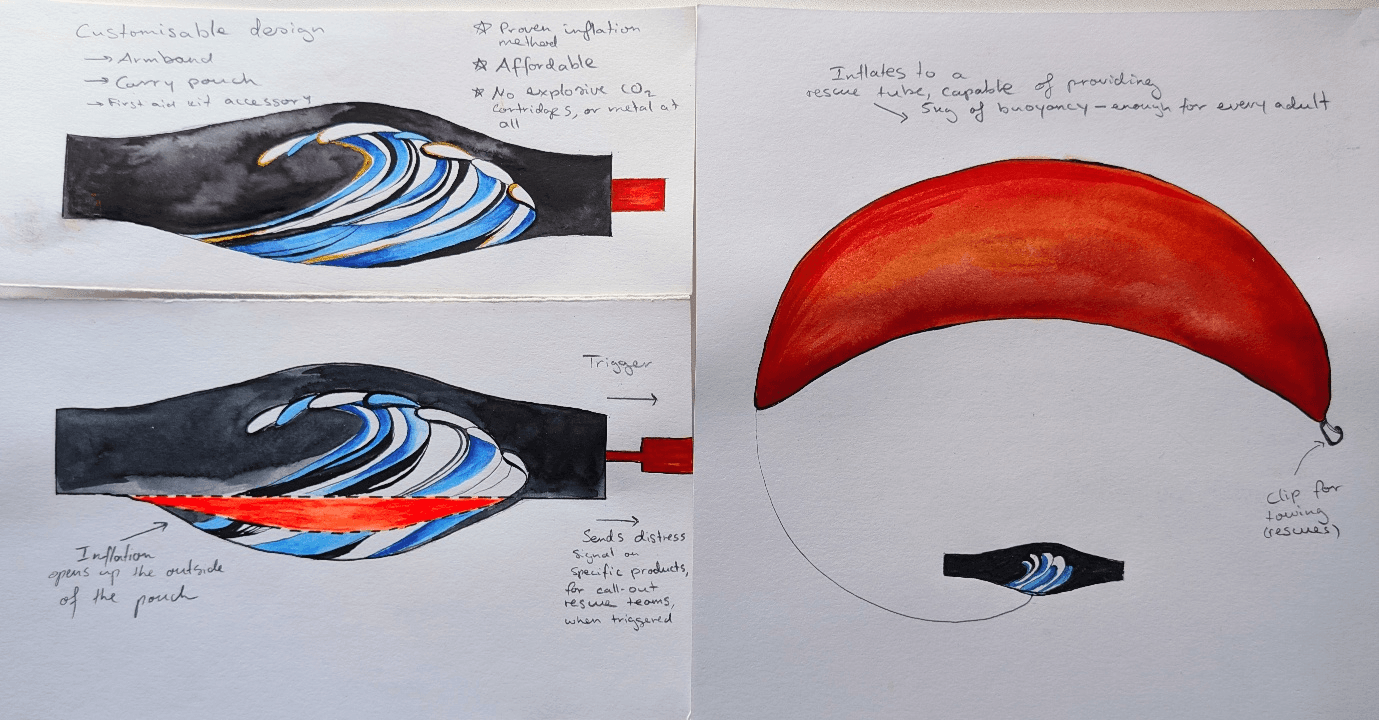 Sketch of ALIS Wear band.
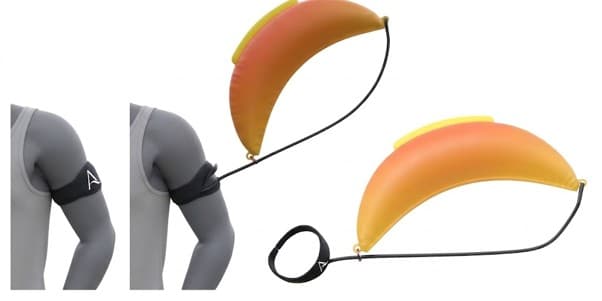 Visual representation of how the ALIS Wear band would be attached to a human arm, and inflate when in need.
Ultimately, a discreet, yet easily accessible trigger is pulled, the bladder inflates and pops out of the armband, and then detaches on a chord to become a rescue tube on demand!
Aside note: From the development side, if I were to showcase anything that might show the reactants, I think my IP lawyer would hit me. So we can’t really showcase the reaction setup or the testing rig at all, until the provisional patent is filed, which will be towards the end of the month. Sorry! This includes all photos I have of working on this with Mitch as well. In the meantime, enjoy a couple of selfies of mine though – that’s the best I am allowed to do sorry.
.png&w=1920&q=75) POV: You mix the wrong chemicals by accident and make a huge mess)
POV: You mix the wrong chemicals by accident and make a huge mess)
You mentioned that you are currently at Technology Readiness Level (TRL) 4. Tell us what the TRL framework encompasses, and why you chose to use it for your development process. In your opinion, what does it take to progress from TRL 4 to TRL 5?
The Technology Readiness Level (TRL) framework is a simple, NASA-derived framework that allows people to easily explain which level their technology is at in the prototyping journey. Funnily enough, both me (Nick) and Mitch come from or adjacent to the space industry. I work with the Canberra Cyber Hub part-time, where I help uplift the space industry in Canberra, and Mitch is a rocket technician at SkyKraft – working on satellites. So, this language is second nature to us.
We ourselves are at a TRL 4, meaning that we have this validated in the lab and each component works well separately. The next level is TRL 5, which, once we reach it, means that each system has been validated in a relevant environment. For us, that means moving the chemical reaction out of the lab (where we use glassware) and into something we can have sitting on a benchtop, where, upon a trigger – a bladder inflates.
So, the real challenge is connecting it all. We know certainly the chemistry works – this has been validated over four months with research at the ANU, and testing has been rigorous. But putting it into vessels that aren’t glassware, is somewhat of an engineering challenge. Liquids love to seep through things, and get everywhere, whilst making an immediate-action trigger mechanism also requires some thought.
But in saying this, we’ve only done final lab tests only two weeks ago, and have been busy writing the results and thesis. So, yes, it’s a challenge, but it’s not terminal – just a little roadblock we’ll have resolved in the next 2-3 weeks.
A TRL 6 is the next big horizon. For us, this would mean the creation of a prototype we can test on the beach. This here is the big step forward. We would have to organise testing frameworks and ethics, potentially in collaboration with Surf Life Saving, explore regulatory requirements, engage industry experts, material scientists, and more mechanical engineers, understand supply logistics, and then manufacture at least 100 prototypes for the first round of testing. It’ll be hard, but that’s why we love it.
Most importantly, it’ll be revolutionary once it works, and we have no doubt that it will. It’s only really a matter of time, money, iterations, prototyping and continual refinement, and we are so excited for this road ahead.
As founders, what is your unfair advantage?
Not only have we had unprecedented early traction in 2.5 months, with over ten surf clubs involved, five universities, over a hundred conversations, and already discussing procurement with SLSA, but also, our radically new approach is what makes us different.
We’ve got the patentable research (being patented now), and a new solution to a problem that arose from multiple personal experiences during rescues, and a deep understanding of our customers and beneficiaries. We truly understand the fundamental problem from our market research and conversations, and have even studied this alongside psychologists; people won’t wear safety equipment if it makes them look like potential victims. And no matter how you approach CO2 cartridges, you will always be constrained by a thick, cylindrical, immovable shape, so making it sleek and fashionable? Forget it. Besides, pressurised cylinders are explosive, rust and produce freezing gas.
We saw this issue, and we… Reinvented the wheel. We made our system much better and safer, using a chemical inflation system that’s fully flexible, can be flattened, or made into any other shape.
Nick founded the company from this research, nine years as a surf life saver and then as an immigrant who’s had near-drowning experiences himself, alongside Mitch - a satellite and rocket technician, engineering student, absolute genius at coming up with crazy new ideas and the most outdoorsy person you’ll ever meet.
We’ve got the full recipe for success: we know the industry and every part of it, we’re learning constantly, we are extremely nimble, and our dedication is unprecedented. Alongside all this, we’re not afraid to risk it, fully understanding that this is a big tackle and a huge goal, with clear barriers and challenges lying ahead. Yet we’re as passionate and stubborn as ever, to truly change the world of water safety once and for all, saving countless lives.


