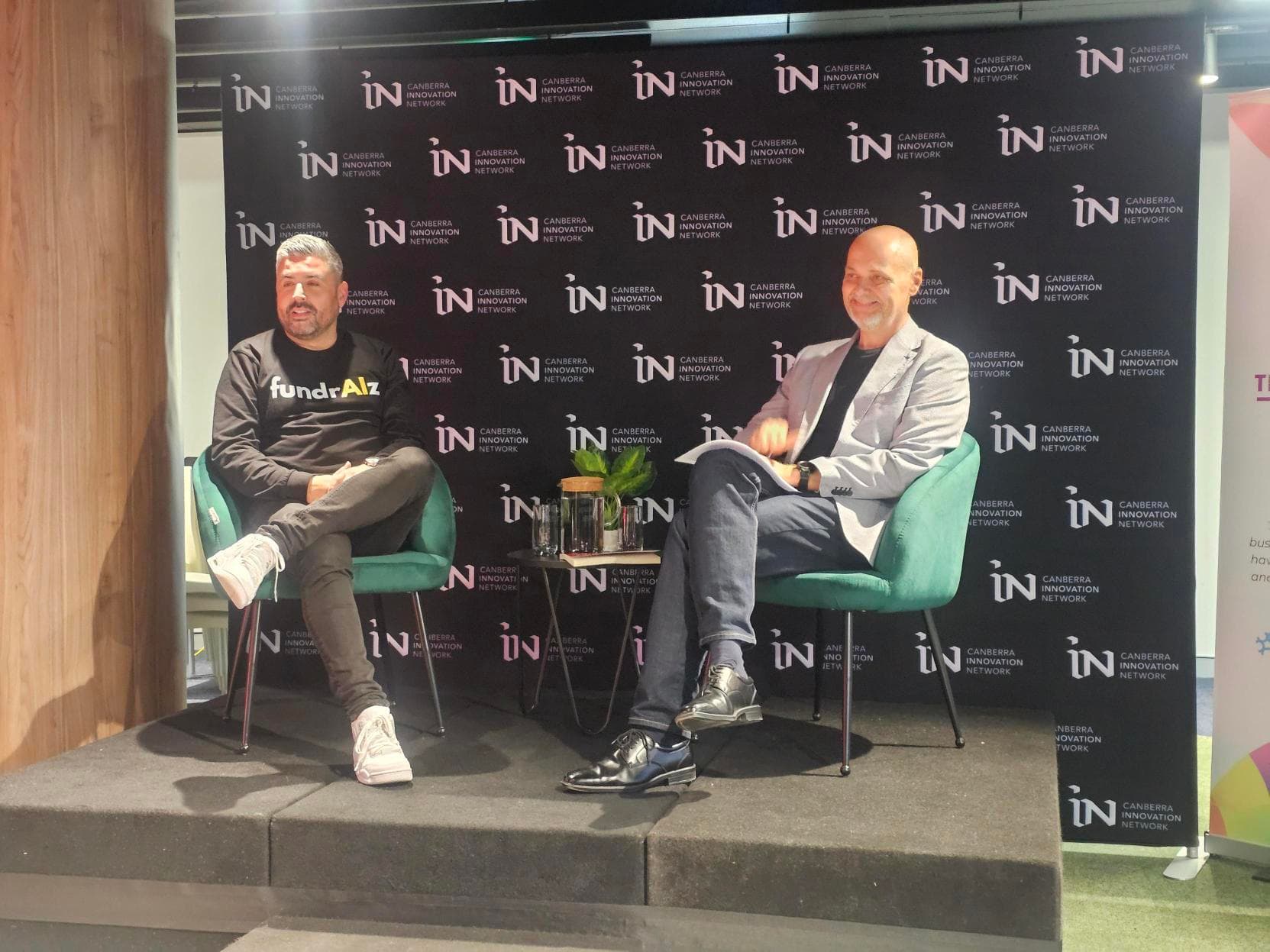
Last week on Friday we welcomed Carlos Aguilera, founder of Fundraiz.ai and author of Just Start Here, to Canberra Innovation Network for a conversation about his new book, AI and the innovation-led future of the charity sector.
In an afternoon supported by the Mill House Ventures, CBRIN and Fundraiz.ai, we covered everything from fundraising and data sovereignty to governance and leadership.
For most organisations, adoption of AI isn't stalled by availability of technology.
It's being held back by hesitation. It is the fear of the unknown. It is the high degree of dynamism and evolving uncertainty. Our first reaction is often an attempt to deny, control or overinvest in 'preparation'.
This often manifests as a somewhat comforting belief that there will be a point in the future (not today) when we'll be "ready". We'll have the well designed and approved AI strategy. The AI governance framework will be completed and everyone will be onboard. Staff will be trained. All the risks will be considered and mediated for.
Then we'll be ready to adopt ai.
The trouble is, the evolution of AI and the way it is used by organisations and people doesn't wait for organisations to catch up.
That of course doesn't mean we should quickly throw sensitive data into every new tool that appears. It means recognising that there is no point where uncertainty disappears. The organisations learning the fastest are the ones willing to experiment, make small adjustments and learn as they go. Accepting that there are risk that are difficult to fully control.
Carlos made another point that is often lost in conversations about AI.
The goal isn't to become a more automated organisation.
It's to become a more human one.
That might sound contradictory until you think about where most people actually spend their time.
Writing first drafts.
Searching for documents.
Summarising meetings.
Preparing reports.
Reformatting information.
None of those activities are why people join charities. They join because they care about a cause, about a community or about helping others.
If AI can reliably (and that is the bit where according to Carlos fundraizr.ai has invested a lot of their effort) take care of some of the repetitive work, it creates more time for conversations, relationships and better decisions. That's where the real value sits.
Of course, charities have every reason to be cautious.
Trust is one of their greatest assets. Getting things wrong (and we will when we trully experiment) is not just an operational problem. It can affect reputation, donors and the communities charities serve.
That's why it really matters that we invest consciously in building AI literacy and AI capability.
Leaders don't need to understand every model or keep up with every product release. They do need to know enough to ask sensible questions: Where does our data go? What information should never leave the organisation? Which tasks are low risk? Which ones need human oversight?
Good governance isn't about saying no to AI. It's about giving people confidence to use it well.
One of Carlos' observations also struck a chord with us. He said the charity sector doesn't really have a technology problem. It has a starting problem.
We suspect that's true well beyond charities. Whether you're running a startup, work in a government agency, a university or an established business, it's easy to spend months discussing AI without having the courage to change how work gets done.
Maybe the better approach is much simpler.
Find one task that wastes time.
Use AI to improve it.
Learn something.
Share and then move on to the next one.
Innovation rarely arrives through a single transformation project that is a top down initiative. More often it happens because people make one practical improvement, discover it works and build from there.
That's probably the key message we took away from the conversation. And it strongly resonates.
Don't wait until you're ready.
Start small.
Learn quickly.
Keep your purpose clear.
The technology will keep changing. That's inevitable.
What matters is whether your organisation is changing with it at a pace that will keep it relevant (and sustainable) in the age of ai.


