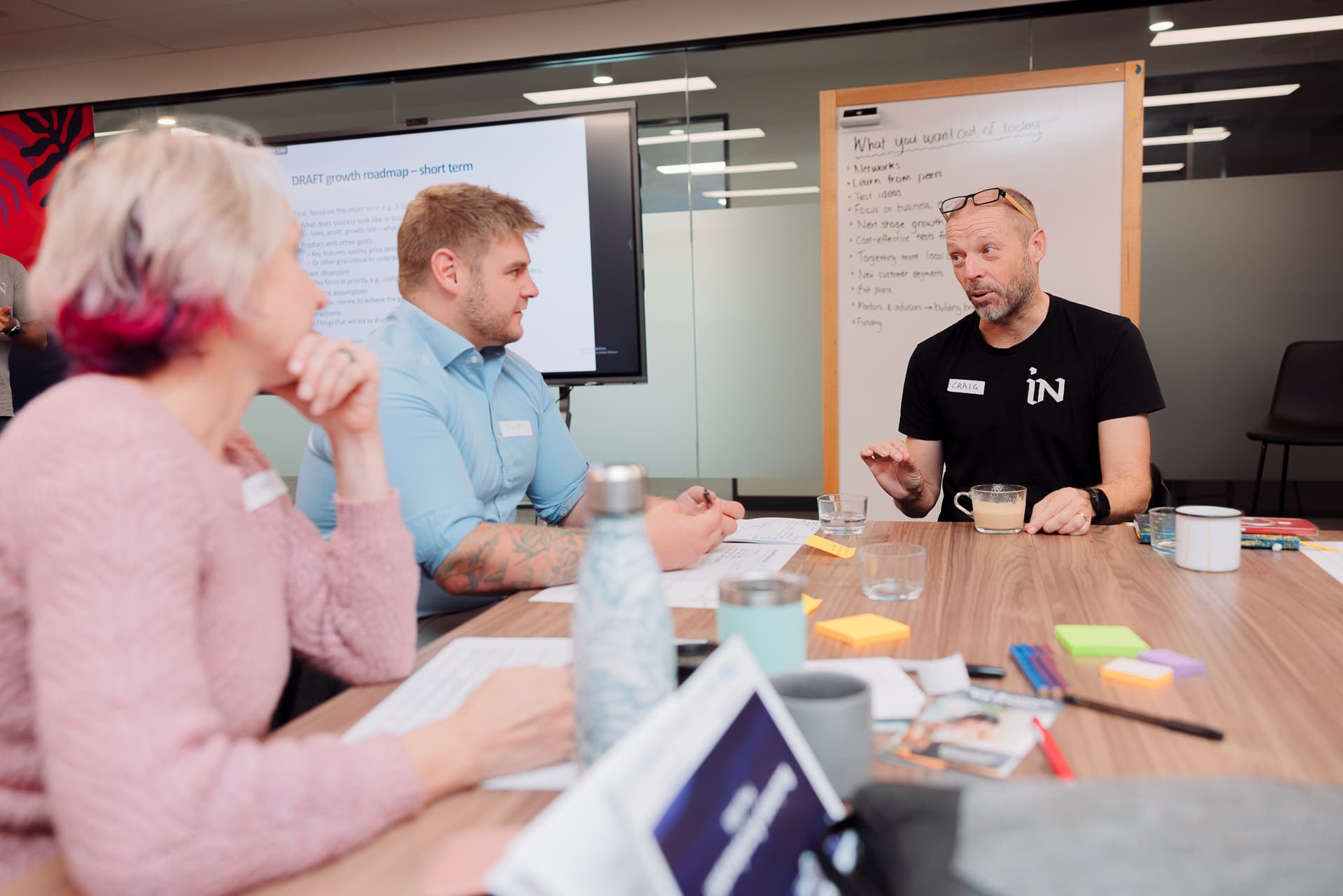
At today’s Entrepreneurship for Everyone event, a collaborative event hosted at the University of Canberra’s Anne Harding Centre, Eamon Cross from WhatWorks challenged participants to think more deeply about how they position their business.
WhatWorks, "works" [get the pun?] across growth, marketing, strategy and digital products. Eamon’s session focused on a simple but often overlooked point: strong businesses do not start with a logo, a campaign or a polished pitch. They start with clarity.
The core questions may sound really simple but they are core and many business owners may not have been thinking about this level of clarity:
- Who are you?
- What problem are you solving?
- Why does it matter that you are the one solving it?
Eamon positioned [get the pun again?] these questions not as abstract brand exercises. They shape real business decisions. They influence who you serve, how you compete, what you build, how you communicate and how people remember you. Answers to these questions are fundamental for your business.
A key learning was the difference between "differentiation" and "distinction". Not every business needs to disrupt a market or invent an entirely new category. But every business does need to be clear, recognisable and easy to understand. In crowded markets, being distinct can matter more than being different for its own sake.
Eamon also spoke about the importance of mental and physical availability: making your business easy to think of and easy to access. For founders, this means positioning cannot live only in a strategy document. It has to show up consistently in the website, product, customer experience, content, sales process and everyday operations.
The session used examples from WhatWorks’ own client projects, including Himayat and Holly Homes [guessing the letter of the day for case studies was "H"], to show how positioning changes practical decisions. For Himayat, the strength was not just the service model, but the organisation’s lived understanding of the communities it served. For Holly Homes, growth came from rethinking how modular housing was communicated to new customer segments without abandoning the company’s original purpose.
One of the most useful ideas from the talk was the concept of a “through line”: a clear thread that connects purpose, strategy and communication. When that thread is missing, businesses can become inconsistent. When it is strong, decisions become easier and the brand becomes more memorable.
For the over 100 present entrepreneurs who came from all walks of life, including migrant communities, people with disability and other groups you may worry can be missing on mainstream ecosystem events, the takeaway was very easy to articulate: Before rushing into marketing, founders need to spend time defining the problem, the audience and the reason their business deserves to exist.
As Eamon put it, a useful test is to ask: if this business disappeared tomorrow, would anyone genuinely miss it?
That harsh question asks founders to focus on value, relevance and purpose. For a room full of entrepreneurs at different stages of their journey, it was a strong reminder that positioning is not a one-off exercise. It is something a business builds, tests and sharpens over time.
CBRIN thanks Eamon Cross, WhatWorks, Himayat and their Growth Hub, the University of Canberra and all partners involved in Entrepreneurship for Everyone for supporting practical, accessible entrepreneurship in Canberra.