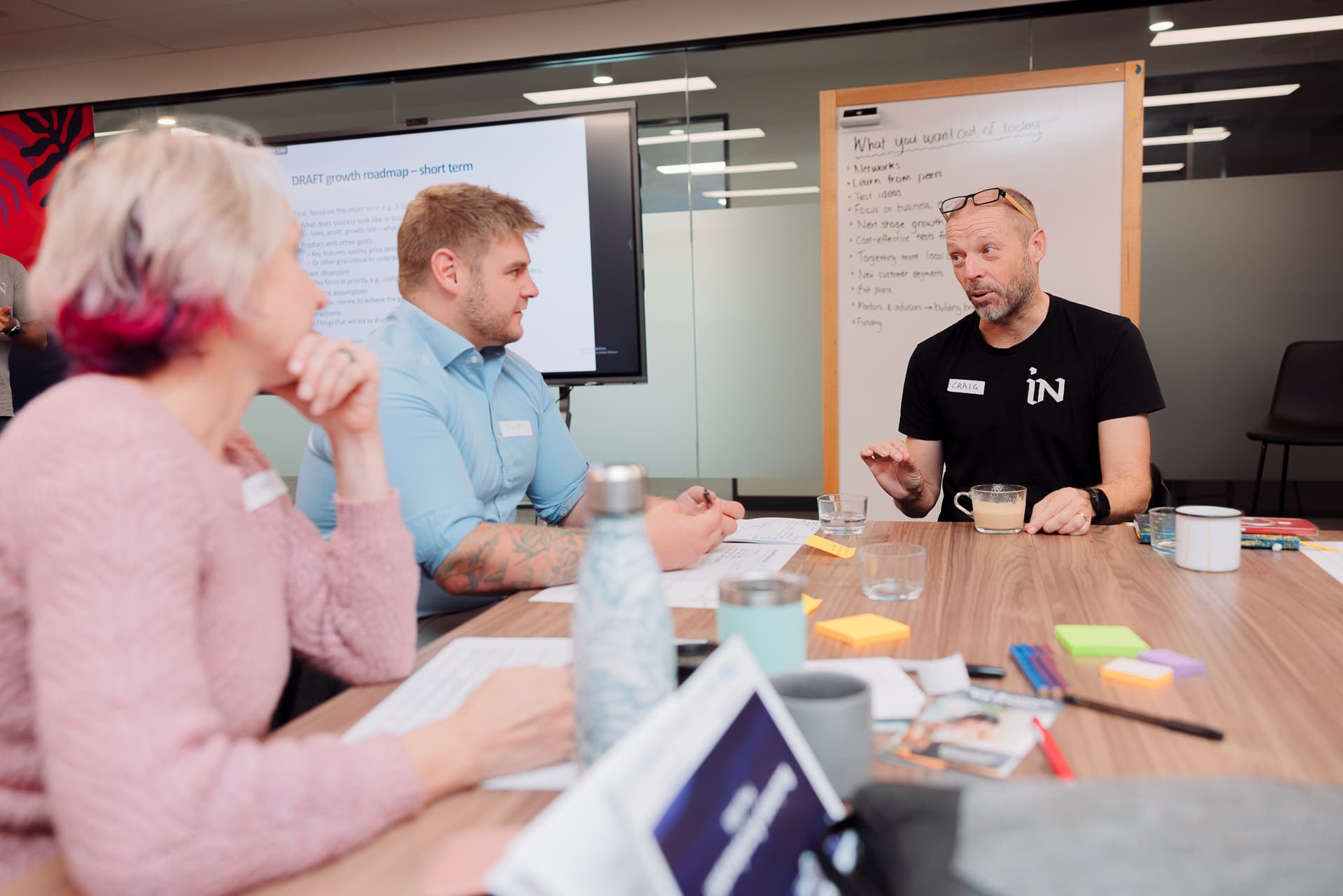
When the entrepreneurs across the table stated their original company valuation, I let out a snort of derision.
It was a pre-planned action, designed to unsettle and make clear that any initial number they trotted out was going to be well beyond the pale.
You see, I had decided today I was going to play the part of a difficult investor.
Not unreasonable—but firm. Focused. Every clause in the term sheet was an opportunity to press for value. If there was ground to take, I would take it. If there was ambiguity, I would lean into it. My mindset was simple - I didn’t really care about the company's product, or vision, or people - my only goal was securing the best possible deal.
This was unusual for me. In reality, outside this simulation we were doing with Nick McNaughton and CBRIN on negotiating terms, I was on the entrepreneur side. I started my own business, ACTS Education, last year and it was going strong. I had therefore decided to do the workshop as it may not be too far away where I might be faced with a hard-nosed, antagonistic investor who wanted a piece of my company.
What I hoped was that the simulation would help me understand better how investors think, what their priorities are, and ultimately whether our futures might be tied together.
The results were fascinating.
Simulations - The bridge between theory and reality
There is a reason that simulation works.
Education has long struggled with the gap between knowing and doing. The negotiator workshop could have involved hours of exploring the definitions of term sheets, walking through clauses, even analysing case studies - but until you step into the emotion and interactions of the applied space, the knowledge remains largely theoretical.
Simulation changes that.
It forces application. It introduces a consequence. It engages feelings, identity, and decision-making under pressure. And importantly, it allows failure without real-world cost.
Unbeknownst to the organisers, I have been passionate about simulation in education for years. In fact, in 2022 I had facilitated a large-scale simulation around Governor Lachlan Macquarie in the NSW Parliament as part of the Bicentennial. Around 30 university students dressed up in character and went through five parliamentary debate sessions, each reflecting a period of history between 1810 and 1825, finalising in a judgment vote of Governor Macquarie and his actions.
This form of learning is called Reacting Education, and it takes the form of a competitive game where each character has a goal to achieve. Instead of just reading about the historical period as an overseer, you walk in the shoes of people who were there and gain a new perspective and understanding that you would have never received otherwise.
Even with my current company, simulations play a central role. We design face-to-face, AI conversational avatar simulations for schools, universities, and training institutions - everything from job interviews to historical figures - to help people learn in interactive ways that ensure effectiveness.
Because the future of education will not be defined by how well we deliver content, but by how effectively we create environments where people can practice, fail, reflect, and try again.
Back to the table
By the end of the negotiator workshop session, we had reached a deal.
I had softened somewhat on my money-hungry snorts and eye-rolls. Not because I didn’t want the best deal, but because I realised a significant truth from the simulation.
The best deal only comes through the right relationship.
What is the point of getting a better share price as an investor if trust is lost? How will a company continue to be driven to greatness when the CEO feels undermined by a money-blinkered board? What will the next round of negotiations look like if the entrepreneurs are already traumatised from the first one?
Relational capital is the most important resource we have, and this becomes all too evident when you effectively simulate the pressures of a business negotiation as Nick and CBRIN were able to do. When you treat an investor or entrepreneur as an opponent, you have already lost - no matter what the outcome.
But when a bond is forged, with kindness, transparency, trust and a joint vision for what can be achieved, then the sky is the limit.
Nick Jensen is the Managing Director of ACTS Education, a Canberra-based edutech startup that designs conversational avatar simulations for schools, universities and training institutions.